

DI-POL
HI-FI open baffle speaker.
A room-first HIFI loudspeaker: designed around the space it lives in—Following Perry Marshall's Designs.
Client
Technology & Realization, Maths Data & Computing, Creativity & Aesthetics
Project Type
Consumer Electronics
Main Deliverables
Floorstanding Speakers, Amazing Sound
Date
August 2024
End Result

Wonder why they are special? Scroll to find out.
What most speakers get wrong.

Many high-end speakers optimize mainly for a flat on axis frequecy response. Perry Marshall, whose Live Edge Dipole design this one is built on, makes the case that this is backward — off-axis radiation and phase get mostly ignored because they’re harder to measure than on-axis response, and that’s exactly what falls apart the moment a speaker leaves the test bench and sits in a real room with more than one person listening.
What were my goals?
The room is part of the system.

Most speakers are designed in an anechoic chamber and dropped into a room. This approach leads to many compromises, so I started with the room and the couch at 3-4 m away, with the projector right in the center. That requirement pushed the speakers towards the side walls — exactly where a typical box speaker would start failing becaue of strong side wall reflections, smearing the sound.
Going Dipole: canceling the reflections where it matters

An open speaker that has no box. It radiates front and back in opposite phase, so the two cancel to the sides: a figure-of-eight pattern with a null at ±90°. Aim the null at the side walls, and the speakers can sit 1m away from them without strong side-wall reflections.
What is the tradeoff?
Cancelling Sideways Also Cancels Bass

That cancellation also eats up the precious bass energy. Below the frequency set by the baffle’s own front-to-rear path length, the front and rear waves start cancelling instead of reinforcing, and output rolls off at roughly 6dB per octave. I could chase that with EQ, but every dB of boost comes at the expense of cone excursion and therefore distortion. So instead of a typical 8-inch woofer, the design utilizes a large 18-inch woofer to move more air as well as tapered side wings.
Why such a big driver?!?!
One point for the mid and treble

First principles logic would tell us that a point source is superior to two drivers because of perfect time alignment- minimizing interference. Thats why the design boasts a coaxial driver. Placing the tweeter right at the centre of the midrange cone, so both bands radiate from effectively the same point on the same axis— coherent through the crossover, symmetric off-axis, greatly enhancing imaging.
Why does a point source even matter?
Measured and tuned to the room

Active crossover and tuning done iteratively. I got there by measuring, not guessing: sweeping the room with REW, setting the crossover in MiniDSP software, EQing, applying FIR phase correction, listening, measuring, and repeating. The final correction gives 2 presets. One averaged across several positions on the couch for group listening and one for solo sessions.
Built by hand from an exotic hardwood
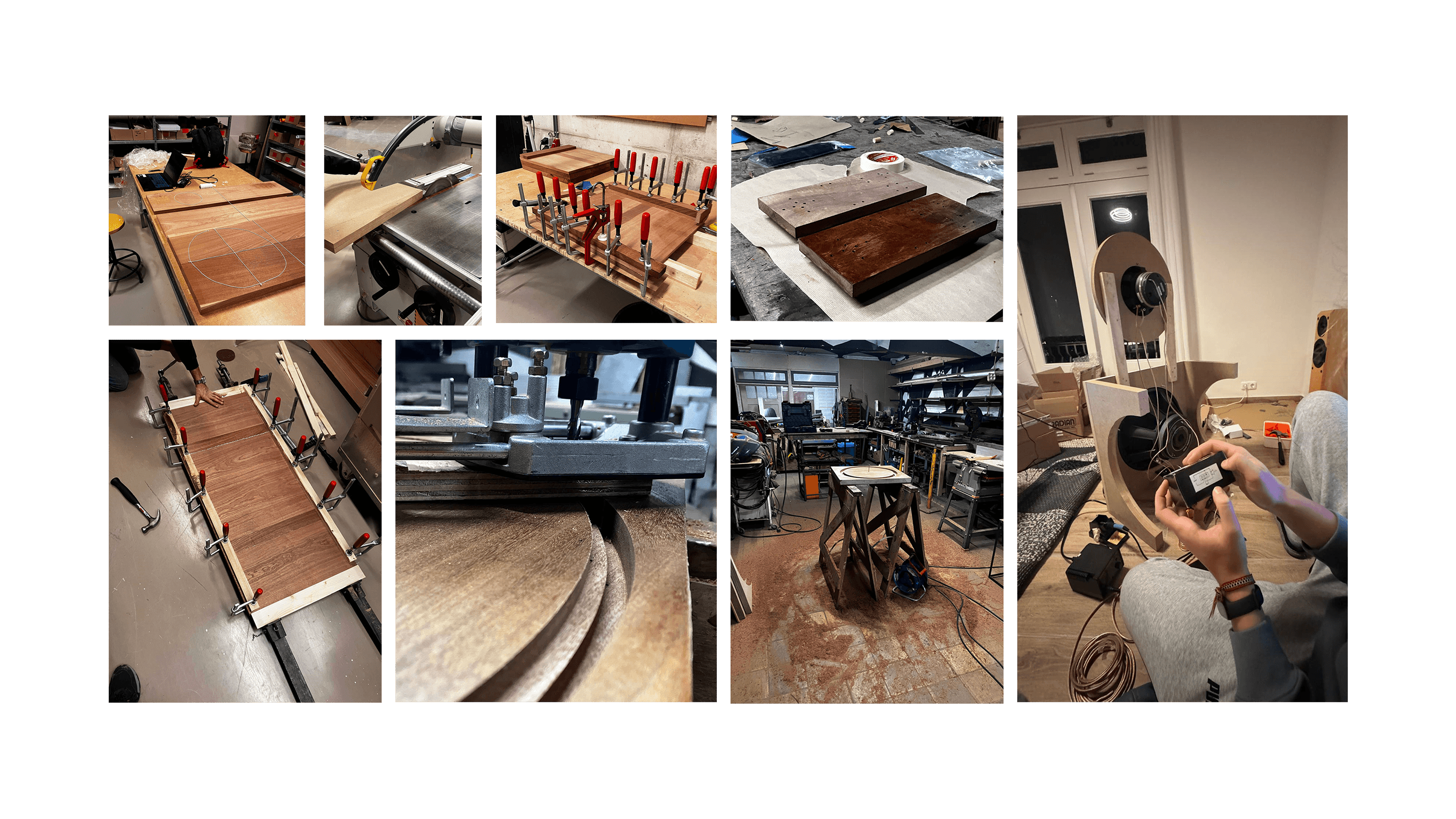
The baffles are solid Sapele hardwood, shaped after Perry Marshall’s Live Edge Dipoles, but sized and built specifically for this room.
Utilized an iterative approach

I utilized sketching, rendering and technical drawings to help bring the final form to life before making.